When the World Spins
Zadie
A lived experience of idiopathic vestibular disease, ageing, and what our animals teach us about care
I have worked in healthcare long enough to understand uncertainty. I know how it feels to sit with incomplete information, to wait, to watch, to hope that time clarifies what tests cannot. I am not frightened by medicine. I respect it deeply.
And still, nothing prepared me for watching my dog lose her balance overnight.
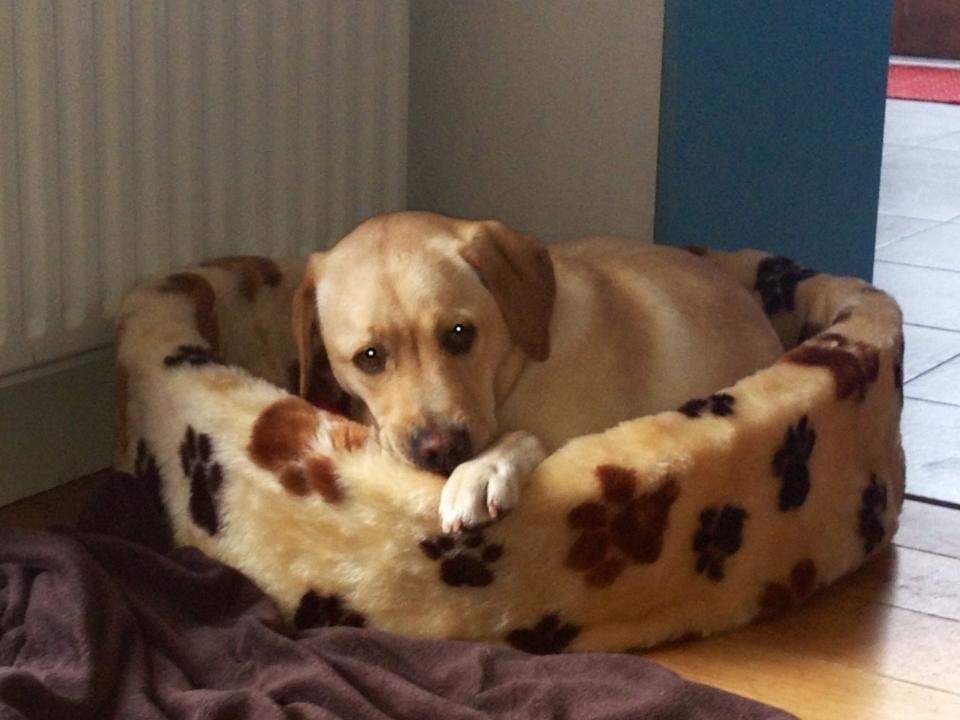
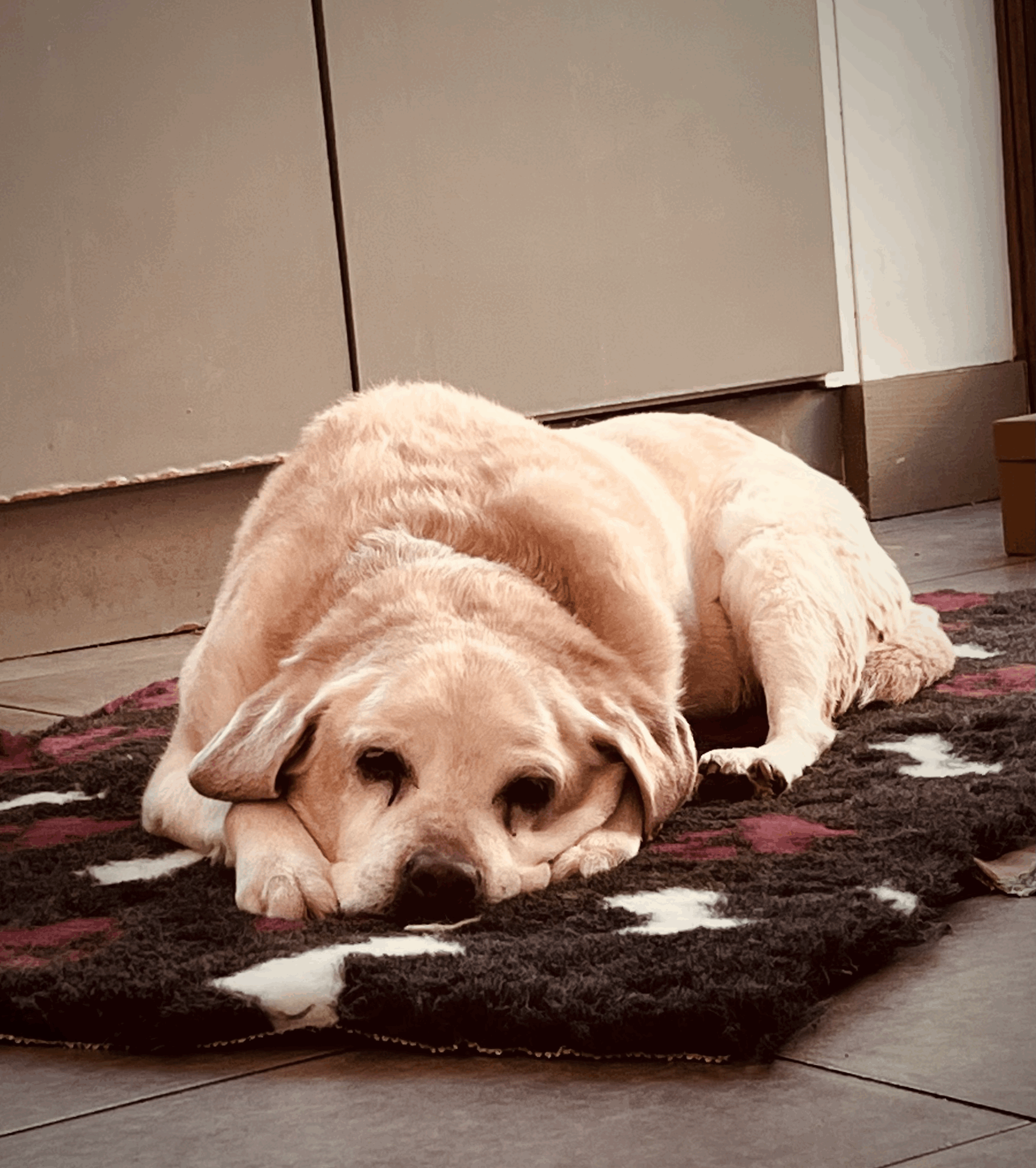
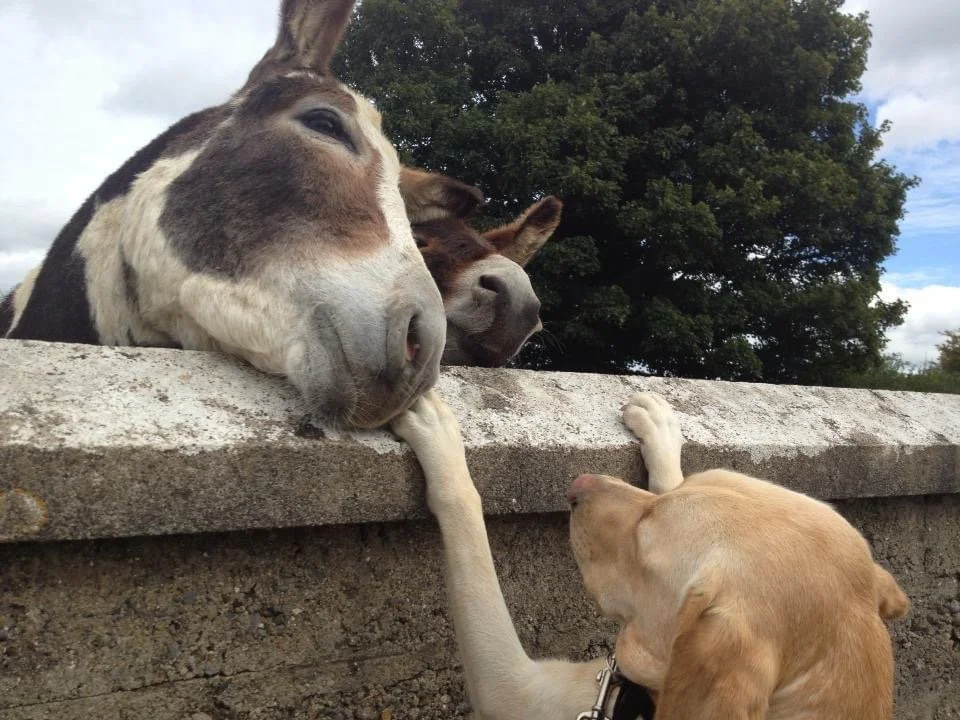
Zadie is my golden Labrador. She will be fifteen in February. She is steady, strong-hearted, sociable, opinionated, and quietly fearless. She has walked with me twice a day for nearly fifteen years. Through stress, grief, joy, routine, and change, she has been the constant that regulated my life far better than any wellness intervention ever could.
I haven’t been a patient in a hospital since I got her. That’s not a coincidence.
When her symptoms began, they were intense. Severe dizziness. Loss of balance. Nystagmus. And overwhelming nausea, far more prominent than vomiting. She felt constantly sick, but rarely actually vomited, which made relief harder to find.
What isn’t often mentioned is how distressing loss of bladder control can be for a dog who has been continent all her life. Zadie found the incontinence almost as upsetting as the vertigo itself. And so began the practical reality of lifting a 30-kilogram Labrador in and out of the garden, knowing that every movement made her world spin, but that staying inside felt just as distressing to her.
There were moments of unintentional levity in the middle of all this. She pooped on the vet. She urinated on my partner and the veterinary nurse. She somehow avoided me entirely, which I choose to interpret as either good aim or excellent judgement. Humour doesn’t minimise fear, but it does make it survivable.
Before she was admitted, we went first to her local veterinary practice. They saw us immediately on the 29th of December. There was no delay, no hesitation, no minimising of what we were seeing.
The environment mattered. Parklane has been intentionally designed with calm in mind. Natural woods. Warm, neutral colours. A space that understands that nervous systems, animal and human, register surroundings long before they register words. That thoughtfulness showed.
Most of all, the care mattered. A vet who truly cares is unmistakable. Not just clinically competent, but present, attentive, and willing to hold concern without amplifying fear. Zadie was examined carefully, thoroughly, and with genuine compassion.
The referral to an emergency hospital was made as a precaution. It was the right call.
She was then admitted to a busy emergency veterinary hospital over New Year’s. Bright lights. Continuous noise. Constant activity. Necessary, skilled, lifesaving care delivered in an environment that is inherently dysregulating for nervous systems, human or animal.
The care was kind. The clinicians were excellent. The skillset was not the issue.
The issue was information.
Over the course of her admission, I spoke to three different vets. Each was competent. Each was kind. Each communicated differently. One explained the diagnosis. Another told me she was stable but still very symptomatic and needed observation. A third said she could stay another night, but that going home might actually help her recover more quickly.
None of this was wrong.
What was missing was a single, coherent narrative.
I never met any of them in person. I spoke to different voices, at different moments, holding different pieces of the picture. And crucially, I never clearly heard the sentence that mattered most, or at least I couldn’t absorb it at the time: she is very likely to improve.
The nurse who handed her back to me at discharge had only just come on duty after holidays. She had no lived knowledge of Zadie’s course. That wasn’t a failure of care. It was a system doing what systems do.
It wasn’t the absence of information that unsettled me. It was the absence of anchoring. Information only reassures when it lands in a way the person receiving it can hold onto.
When Zadie came home, she shook for the next 24 hours. She was traumatised. Not by the people, but by the environment and the separation from the only reference point she understands. Dogs don’t know why they are in hospital. They don’t know what comes next. Humans do. That knowledge matters more than we sometimes admit.
I slept on the sofa beside her for the first week. I did not leave her side for the first 24 hours. Not because I was panicking, but because her nervous system needed a stable external anchor while her internal one recalibrated.
This is the part of idiopathic vestibular disease that doesn’t show up in discharge summaries.
Idiopathic vestibular disease is most often a peripheral inner ear event. It is dramatic, frightening, and usually self-limiting. The first 24 to 72 hours are the worst. Improvement often comes in uneven waves. Gait can be worse in the mornings. Confidence lags behind physical ability. A residual head tilt may remain. Most dogs adapt beautifully.
Knowing that changes everything.
Not knowing that changes you.
Within days, Zadie began to eat again. Then drink. Then walk, cautiously at first, then with increasing confidence. I followed her pace, not mine. Short walks. Familiar routes. Choice over coercion. Within a week, she was walking with her dog friend again, self-directing the length, her confidence already bordering on fearless. That is her nature.
She is now about 85 percent recovered. The rest will come, or it won’t, and either way she will live fully inside whatever body she has today. Dogs do not mourn their former selves. They adapt.
There is something profoundly instructive in that.
Living with a dog means you exercise every day. Twice a day. Whether you feel like it or not. It means you are pulled out of rumination and into weather, light, routine, and connection. It means another being depends on you not just for food, but for safety, interpretation of the world, and emotional regulation.
That responsibility is not a burden. It is a shaping force.
Zadie’s heart is strong. Her health is remarkably good for her age. We manage her weight as best we can as her metabolism slows. She has no chronic disease. That didn’t happen by accident. Movement, routine, companionship, and living in the present are not soft concepts. They are physiological interventions.
We know this in human medicine. We just struggle to live it out in real clinical settings.
What this experience sharpened for me is how much unnecessary suffering arises not from illness, but from gaps in communication. In veterinary and human healthcare alike, people are often left with a diagnosis or the absence of one, a prescription, and a follow-up months away.
Clinicians are kind. They are skilled. They are overstretched. And yet patients and caregivers leave holding fear rather than understanding.
Clear, anticipatory explanation does not take more time. It saves it. It reduces panic-driven calls, improves compliance, deepens trust, and protects clinicians from the slow erosion of burnout that comes from managing distress that could have been prevented.
So I did what many people now do when they are trying to make sense of uncertainty. I went looking for understanding.
I turned to ChatGPT. Not for diagnosis or treatment, but for explanation. I have a medical background. I understand the difference between clinical decision-making and informational support. What I needed was context, pattern recognition, and reassurance grounded in physiology rather than fear.
It helped because it filled in the spaces between facts. It explained what recovery often looks like. It normalised the unevenness. It gave language to what I was observing. That didn’t replace veterinary care. It supported my ability to cope with it.
Zadie taught me, again, that presence matters. That recovery is not linear. That fear thrives in uncertainty. And that bodies, when supported rather than forced, often know how to find their way back.
I never considered giving up on her. Not because I am heroic, but because commitment is the quiet contract you enter into when you bring a dependent being into your life. Dogs don’t get to opt out when things are frightening. They rely on us to hold steady until the world makes sense again.
She did that for me for fifteen years.
This time, it was my turn.